Friday, April 22, 2022
Christiane Amanpour
Good Night, and Good Luck
Thursday, April 7, 2022
EOTO #3 Trial By Media
Trial by media is a popular phrase that has been used in the late 20th century and early 21st century to describe the impact of television and newspaper coverage on a person’s reputation by creating a widespread perception of guilt or innocence before or after a verdict in a court of law.
The media conducts a separate investigation that builds up thew public opinion against the accused before the case even reaches the court. In recent years the media has been seen as a "public court" and has began to interfere in court proceedings.
The problem with trial by media is that the media misuses freedom of speech and expression which creates an interference in the process of the justice system. In the past there have been multiple occasions when the media has been accused of conducting a trial of the accused and passing the verdict before the court passes their own judgement.
This has a major effect on the accused because as a result of the exposure by the media, the individual whether guilty or innocent will have to live under intense public scrutiny. Their social image is also ruined by it.
Under the sixth amendment, every defendant is entitled to a trial by an impartial jury, but due to extensive media coverage, jury selection in a high profile case is extremely difficult. Jurors will likely have developed some biases or knowledge about the case based on media coverage. Potential Jurors are assessed during the void dire process.
There are numerous ways that the court can address pre-trial publicity. Despite the biasing effect of pre-trial publicity, the Supreme Court has ruled that courts cannot stop the press from publicizing truthful information about criminal trials and in doing this it would be a violation of the First Amendment right too freedom of the press. Pre-trial publicity cannot be prevented, which means that courts must find ways to minimize its impact on the fairness of the trial.
There are some famous trials that have "trial in the media" involved. These are: Ted Bundy (1980), OJ Simpson (1995), Casey Anthony (2011), and Jodi Arias (2015). Out of all of these, the trial of OJ Simpson is probably one of the most famous.
OJ Simpson was a former NFL star who was acquitted in 1995 for the murder of his ex-wife Nicole Brown Simpson and her friend Ronald Goldman. On the night of June 12, 1944, Simpson's ex-wife and her friend Ronald Goldman were found murdered outside of her home. Simpson soon became a suspect and instead of surrendering to the police, he hid inside the back of a sport-utility vehicle driven by his friend A.C Cowlings. After law enforcement was notified that Simpson had a gun, they followed the car for over an hour.
Because OJ Simpson was a known NFL player, many individuals viewed him as a good guy, not being able to commit such a crime. This automatically caused conflict because so many people already had different views on him whether it was good or bad. The trial was then turned into a racial issue. Coverage began to turn further away from the truth and began to report lies instead of facts. The media published stories before confirming any of the facts and they had people write stories that did not know what they were talking about in actual court proceedings.
Sunday, March 6, 2022
EOTO #2 Mary Ann Shadd
Mary Ann Shadd was born in 1823 in the slave state of Delaware. Her parents were dedicated to helping the refugees and were dedicated to abolitionism. They then moved to Pennsylvania, when Shadd was 10 and she got an educated and became a teacher.
When they got to Pennsylvania, her parents helped freedom seekers, but when the Fugitive Slave Act in 1850 passed, which said that anyone that was caught trying to help a runway slave could be fine or punished, it became very dangerous for them.
In 1850, after the Act was passed, her and her brother moved to Canada. She met and married a barber, Thomas J. Cary. While living in Canada, she decided to open up a school for black and white students. She also wrote and lectured about the importance of freedom while living in Canada with her husband.
Because of her writings and lectures, she wanted to start a newspaper. So, on March 24, 1853, she became the first black, female newspaper editor in North American history when she published Canada's first antislavery newspaper called The Provincial Freeman. Their slogan was "devoted to antislavery, temperance, and general literature".
During the Civil War, she decided to move to Washington D. C where she helped in the war effort. She also kept teaching at public schools. In 1863, she worked as a Recruiting Officer for the Union Army and encouraged African Americans to join the war.
She then wrote for a local African American newspaper The New National Era and gave speeches to African Americans to recover from the slavery era. She is also the founder of the Colored Women’s Progressive Franchise Association.
In 1998, Mary Ann Shadd Cary was inducted into the National Women's Hall of Fame. Also for her work as a newspaper editor and for her community leadership, she was recognized as a Person of National Historic Significance by the Government of Canada in 1994.
Monday, February 21, 2022
Press and War
For decades, the media has been very prominent in wars that have gone on around the world. From World War I to the Civil War, the press has always covered the events that unfolded. After World War I, the world was changed and people were seeking answers to how to continue living in this new uncertain world. In an article in The Harvard Gazette, a Harvard historian discusses the role of war journalism after the War and how journalist took the new world to their advantage.
Historian Nancy F. Cott, focuses on in her new book, “Fighting Words: The Bold American Journalists Who Brought the World Home Between the Wars.” The book focuses on the work of four American journalists, Dorothy Thompson, Vincent Sheean, John Gunther, and Rayna Raphaelson, between the two World Wars. One point that people today should take from her book is one parallel that she find true in the book and in the world today is that "international journalists then, including the ones in this book, by making it a major issue that Americans had to be concerned about these failings, showed that Americans could not take their constitutional system and its continuation for granted. I think that’s very true today, too."
Not only was journalism present in the two World Wars, but the Iraq/Vietnam War as well. The Atlantic has an article about The Iraq War and how the media is present in that and how the media actually changes what the public can see and know. Cullen Murphy talks about his experience as a journalist for The Atlantic while the Iraq War was going on.
Nothing about the fundamentals had changed for the better since Vietnam. War was still war. The White House still insisted on its version of facts, with questionable evidence to back them up. The press corps was larger and more fragmented than it had been in 1968, and the news moved at a faster pace. TV crews didn’t need to wait for an airplane to carry film canisters from Saigon to Tokyo for satellite transmission. Print journalists could write stories that would be published online within minutes. Cable channels aired news programming around the clock, and their reach was global. None of this fostered a spirit of calm analysis.Unlike in Vietnam, few of the reporters who went to Iraq were military veterans. Many came to the war without much relevant experience. It wasn’t just Iraqi culture that was unfamiliar. In an experiment, the Pentagon allowed some 600 journalists to embed with military units. Soon after arriving in Iraq, Michael Kelly wrote back about an orientation briefing for the embeds where the colonel in charge had to explain certain realities to a reporter from Japanese television, who wanted to know if instead of a backpack she could bring a roller-board suitcase.One takeaway from his article is that "the conflicts change, but the factors influencing the quality of the coverage, including ignorance, confusion, or competition, stay consistent."
News and press to go hand in hand with the coverage of wars has been a prominent issue for so long that even in 2007 the United States Institute of Peace contributed an article about the role of media in conflict.
There were three themes that were prominent in this article: international media has the potential to influence governments and international organizations, and as such can have an agenda-setting effect, these reports however are not always the most accurate reflection of the relative severity and risk of a particular conflict; donors that are interested in conflict prevention and sustaining stability should support local media, as it yields non-tangible results in war-torn communities, such as increased levels of trust, increased hope in the future of the country, and the ability to contribute to a peaceful society; and guarantees regarding the media and freedom of the press, as well as efforts to promote professional, objective, unbiased reporting, should be an integral part of any successful peace agreement.
Tuesday, February 15, 2022
Extra Post 1
“I’ll love you forever,
I’ll like you for always,
As long as I’m living,
My baby you’ll be”
That is the repetitive verse from the book “Love You Forever” by Robert Munsch. My mom used to read this book to me every night when I was a little girl.
The story is about a boy and mother and how her love for her son continues through the stages of life. On the end of every page, she sings the song to him while she rocks him. In the end, the boy is now a grown man, and the mother is elderly. The roles switch and the son rocks the mother and sings “I’ll love you forever, I’ll like you for always, as long as I’m living, my mommy you’ll be”.
The bond that my mom and I made because of this book fills my heart. On the last day that I was home before moving into college, we sat together and read this book. It is a memory that I will cherish forever and a tradition that I want to have someday with my future family.
Having such a close bond with my mom made it difficult to go far away to college, but now the memories that we make when I come home are that much more special to us. I think growing up having a book or song to look forward to or to connect you to someone is important.
It was important to me and my mom because of that fact that I’m her adopted daughter, so we didn’t have that skin-to-skin bond when I was a baby and she got to see me for the first time in an orphanage at 6 months old. It doesn’t matter who you share DNA with, its who loves you unconditionally, and will always be there to support you. That is my mom.
Friday, February 4, 2022
EOTO #1
The San Francisco Examiner was founded in 1863, as the Democratic Press, a pro-Confederacy Paper. The paper's popularity increased with the help of writers like Ambrose Bierce, Mark Twain, and Jack London. Through the middle of the 20th century, The Examiner was one of several dailies competing for readership in the city and Bay Area. The Examiner was originally owned by William Randolph Heart Sr. who then gave the company to William R. Heart Jr.
After Lincoln's assassination, the paper's offices were destroyed by a mob and starting June 12, 1865, the paper was called the Examiner.
Hearst also pushed sensational coverage and foreign news and gave The Examiner is "Monarch of the Dailies" moniker. In the middle of the 20th century, The Examiner was one of several dailies competing for readership in the city and Bay Area.
As part of a deal to purchase the chronicle in 2000, the Hearst Corp. sold the examiner to the politically connected Fang family. In January 2021, Clint Reility Communications announced its purchase of the Examiner and then in April 2021, he assembled new leaders.
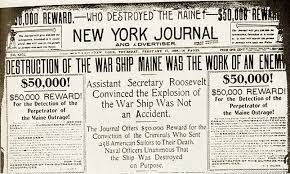
The paper infamously reported on and influenced events like the Spanish-America War. The Sunday's editions also had contained additional supplements.
The paper soon "became known for its sensationalism" which was designed for the readers emotions rather than their intellects.
The Journal consumed most false or exaggerated stories about the tensions between the United States and Spain which caused public sentiment against Spain and influenced the War.
Later the morning Journal changed its name to the New York American and then merged with the Evening Journal, changing the name to the New York Journal American.
Both of these papers have been critical in the Journalism industry and still today are in the top newspapers for the country.
Collateral
On July 12, 2007, two U.S, AH-64 Apache helicopters in Al-Amin al-Thaniyah, New Bagdad conducted an attack known as the Bagdad airstrike af...
-
Christiane Amanpour was born in London, England on January 12, 1958. She grew up in London and went to New Hall School. She then moved to...
-
The San Francisco Examiner was founded in 1863, as the Democratic Press, a pro-Confederacy Paper. The paper's popularity increased wit...
-
Mary Ann Shadd was born in 1823 in the slave state of Delaware. Her parents were dedicated to helping the refugees and were dedicated to ab...